
Visa
H-1B Visa Extension Rules and Eligibility in 2026: A Complete Guide
H-1B Visa Extension Rules and Eligibility in 2026: A Complete Guide Home H-1B Visa Extension Rules and Eligibility in 2026: A Complete Guide The H-1B


Technology is no longer a backstage function—it has become the heart of strategy, innovation, and long-term competitiveness. As we move into 2026 and beyond, businesses are rapidly evolving to keep pace with smarter, faster, and more intelligent systems.
AI has moved far beyond simple automation and has become a foundational engine across industries, enabling organizations to use predictive analytics for sharper decision-making.
With the rise of AI copilots and autonomous systems, AI is no longer a supporting tool—it's the structural backbone for business scale, accuracy, and agility.
This shift is pushing leaders to redesign processes around intelligence rather than manual execution, creating more efficient and responsive business operations.
GenAI 2.0 brings refined accuracy, better governance, and deeper enterprise integration, enabling businesses to rely on it for rapid innovation and structured creativity.
Businesses now leverage GenAI for product design simulation, creating virtual prototypes and testing concepts before physical production begins.
Development teams use GenAI to accelerate software development, automating code generation, testing, and optimization processes.
Marketing departments leverage GenAI for content creation, campaign optimization, and hyper-personalized user engagement at scale.
By 2026, hybrid quantum-classical systems are slowly becoming practical, especially in optimization-heavy industries where traditional computing reaches its limits.
From drug discovery to financial modeling, quantum systems are enhancing compute power where classical systems struggle, opening new possibilities for complex problem-solving.
Although widespread adoption is still developing, businesses investing now are preparing for a future defined by exponential processing capabilities.
Advanced AI systems predict potential cyber threats before they materialize, enabling proactive defense measures against evolving attack vectors.
Zero-trust architecture requires continuous authentication, verifying user identity and access rights throughout the session rather than just at login.
Advanced biometric systems provide multi-factor authentication that's both more secure and more convenient than traditional password-based systems.
AI-powered systems automatically detect, contain, and remediate security incidents, reducing response time from hours to minutes.
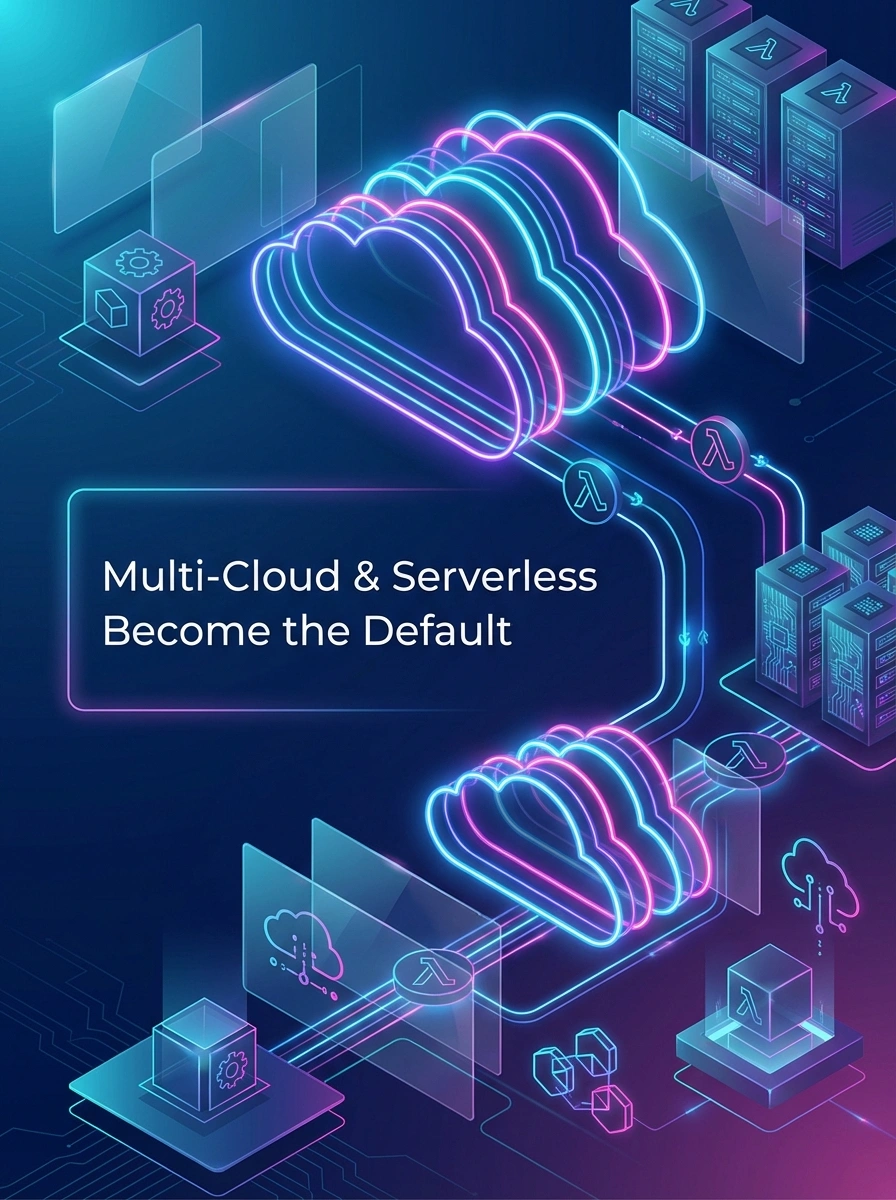
In 2026, organizations are choosing multi-cloud architectures to reduce outages, improve flexibility, and escape vendor lock-ins. This approach provides redundancy and optimization opportunities.
Digital twins have matured into powerful systems that replicate factories, buildings, products, and entire cities with remarkable accuracy.
This blend of AI, IoT, and simulation delivers faster innovation and risk-free experimentation, transforming how businesses approach design and operations.
Web3 is gradually moving from theory to functional enterprise use. Companies are adopting decentralized identity systems that give users control over their digital identity while enabling secure verification processes.
Businesses are implementing blockchain-based audit trails and automated smart contracts to ensure greater transparency, secure transactions, and efficient compliance processes across their operations.
While mainstream Web3 adoption is still emerging, early enterprise adoption is shaping future business ecosystems where users maintain more control over digital assets and identity, creating new models for value exchange.
Warehouses deploy intelligent robots that collaborate with human teams for inventory management, picking, and packing operations.
Automated quality inspection stations use computer vision and sensors to detect defects with greater accuracy than human inspectors.
Hospitality operations are enhanced with robot-assisted services, from front desk check-ins to room service delivery.
AI-managed administrative workflows automate document processing, scheduling, and routine communications.
AR/VR tools are enhancing remote teamwork, design reviews, and employee training by creating shared virtual environments where participants can interact with 3D models and data visualizations.
Businesses are merging digital overlays with physical environments, enabling better on-site visualization, field support, and product demonstrations that blend physical and digital information.
Immersive environments reduce travel costs and deliver more interactive training experiences that boost learning outcomes through hands-on virtual practice and simulation.
| Sustainability Initiative | Business Impact | Implementation Status |
|---|---|---|
| Green Data Centers | Reduced energy costs, improved ESG scores | Widely Adopted |
| Carbon-Aware Computing | Optimized resource usage, lower carbon footprint | Growing Adoption |
| Renewable Energy Solutions | Long-term cost stability, energy independence | Strategic Priority |
| AI-Powered Sustainability Analytics | Real-time carbon tracking, smarter ecological decisions | Emerging Technology |
| Environmentally Responsible Supply Chains | Enhanced brand trust, regulatory compliance | Increasing Focus |
The technology landscape of 2026 represents the most transformative era businesses have ever seen. AI, quantum computing, autonomous systems, Web3, and green innovation are rewriting the rules of competition and value creation.
To thrive, companies must embrace these changes and build future-ready digital ecosystems that can adapt to rapidly evolving technological capabilities.
Organizations that invest today will dominate the markets of tomorrow.
H-1B Visa Extension Rules and Eligibility in 2026: A Complete Guide Home H-1B Visa Extension Rules and Eligibility in 2026: A Complete Guide The H-1B
What Is AI’s Biggest Impact on Modern App Development? Home AI’s Biggest Impact on Modern App Development In the last decade, app development has transformed
Top Tech Trends Reshaping Business in 2026 and Beyond Home Top Tech Trends Reshaping Business in 2026 and Beyond Technology is no longer a backstage