Nemo IT Solutions

Top AI Cybersecurity Tools for Enterprises in 2026

Home - Artificial Intelligence - Top AI Cybersecurity Tools for Enterprises in 2026
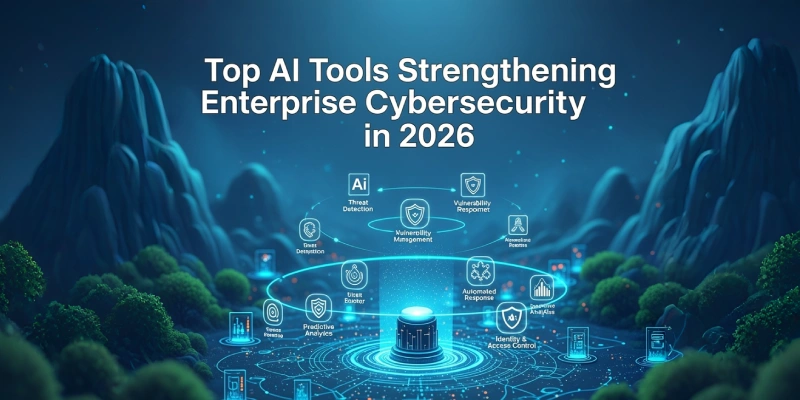
Top AI Tools Strengthening Enterprise Cybersecurity in 2026

Top AI Tools Strengthening Enterprise Cybersecurity in 2026

Cyber threats in 2026 are faster, stealthier, and increasingly AI-driven. Traditional signature-based security tools cannot keep pace with:

zero-day exploits
identity-based attacks
ransomware automation
cloud misconfigurations
AI-generated phishing campaigns

Enterprises are now adopting AI-powered cybersecurity platforms that detect anomalies in real time, automate investigation workflows, and reduce response time across Security Operations Centers (SOCs).

This guide highlights proven enterprise AI cybersecurity tools widely used across cloud, endpoint, identity, and infrastructure protection environments.

Why Enterprises Are Adopting AI Cybersecurity Platforms

Modern enterprise infrastructure includes:

multi-cloud deployments
SaaS ecosystems
remote endpoints
containerized applications
API-driven architectures
AI copilots and LLM integrations

AI security platforms help organizations:

detect unknown threats faster
reduce alert fatigue
automate SOC workflows
strengthen zero-trust architectures
prioritize high-risk incidents intelligently

Core Capabilities of AI-Driven Security Platforms

Leading enterprise solutions combine multiple intelligent security layers:

Capability Security Benefit
Behavioral analytics Detects insider threats and lateral movement
Machine learning anomaly detection Identifies unknown attack patterns
NLP phishing detection Blocks social engineering attacks
Threat intelligence correlation Improves attack visibility
Automated response workflows Reduces containment time

These capabilities enable security teams to monitor millions of telemetry signals continuously.

Leading AI Cybersecurity Platforms Enterprises Are Using in 2026

Below are enterprise-grade platforms widely deployed across SOC teams and cloud environments.

1. Darktrace - Autonomous Threat Detection Platform

Best for: Network-wide behavioral anomaly detection

Key capabilities:

Self-learning AI builds baseline activity profiles
Detects insider threats and lateral movement
Protects cloud, SaaS, email, IoT, and endpoints
Autonomous response containment features

Enterprise value:

Detects unknown threats without signatures
Reduces dwell time of attackers
Strengthens hybrid infrastructure monitoring

2. CrowdStrike Falcon - AI-Driven Endpoint Protection

Best for: Endpoint detection and response (EDR/XDR)

Key capabilities:

Behavioral AI threat detection engine
Real-time endpoint visibility
Identity-aware attack prevention
Cloud-native architecture scalability

Enterprise value:

Protects distributed workforce devices
Supports zero-trust security frameworks
Stops malware before execution

3. SentinelOne Singularity - Autonomous SOC Security

Best for: Automated threat remediation

Key capabilities:

Real-time behavioral monitoring
Ransomware rollback protection
AI-driven remediation workflows
Cross-environment attack visibility

Enterprise value:

Reduces manual SOC intervention
Accelerates incident response time
Prevents ransomware escalation

4. AccuKnox - Cloud & Kubernetes Runtime Protection

Best for: Container and DevSecOps security environments

Key capabilities:

eBPF-based runtime visibility
Kubernetes workload protection
Policy automation with AI copilots
Compliance enforcement monitoring

Enterprise value:

Secures containerized workloads
Supports cloud-native architectures
Automates runtime policy enforcement

5. Check Point Software Technologies Infinity AI Copilot

Best for: Unified enterprise threat prevention

Key capabilities:

AI-assisted threat investigation
Automated firewall policy tuning
Cross-environment visibility
Identity-aware protection models

Enterprise value:

Reduces configuration errors
Improves SOC investigation speed
Strengthens prevention accuracy

6. Microsoft Defender XDR

Best for: Microsoft ecosystem security environments

Key capabilities:

Identity threat detection
Endpoint telemetry correlation
Email threat monitoring
Automated investigation workflows

Enterprise value:

Centralized security monitoring
Strong integration with enterprise identity systems
Improves zero-trust implementation readiness

7. Palo Alto Networks Cortex XSIAM

Best for: AI-powered SOC automation

Key capabilities:

Attack surface analytics
Threat intelligence correlation
Automated alert prioritization
Incident investigation automation

Enterprise value:

Reduces alert noise dramatically
Improves analyst productivity
Accelerates mean-time-to-response (MTTR)

8. Google Threat Intelligence (Gemini-Powered)

Best for: External threat intelligence monitoring

Key capabilities:

Tracks threat actors automatically
Analyzes global attack indicators
Detects dark-web exposure risks
Provides contextual investigation insights

Enterprise value:

Strengthens proactive defense strategy
Identifies emerging cyber campaigns early
Enhances intelligence-driven security posture

9. Prompt Security - Enterprise GenAI Protection Layer

Best for: Securing enterprise AI usage

Key capabilities:

Prevents prompt injection attacks
Protects proprietary data leakage
Monitors LLM interactions
Enables AI governance enforcement

Enterprise value:

Enables safe GenAI adoption
Supports compliance requirements
Protects internal knowledge assets
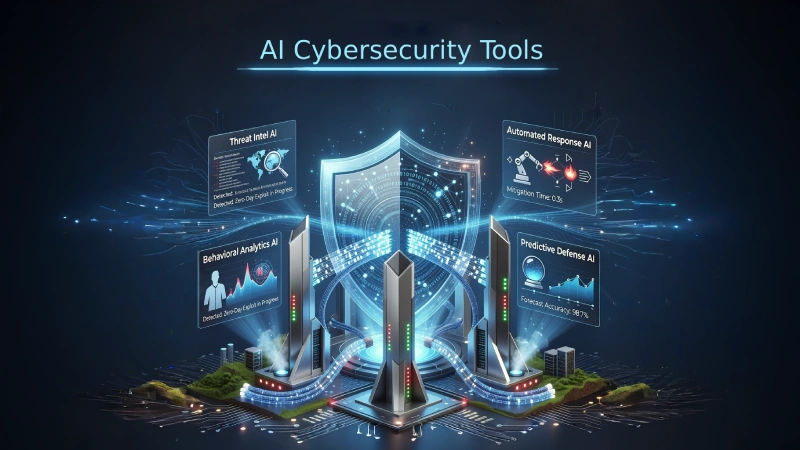
AI Cybersecurity Tools

Key Benefits of AI Cybersecurity Tools for Enterprises

Organizations implementing AI-driven security platforms gain measurable advantages:

Faster Threat Detection

AI continuously analyzes behavior instead of relying on static signatures.

Reduced Alert Fatigue

Automation filters low-risk signals and highlights critical incidents.

Stronger Cloud Security

AI monitors APIs, workloads, containers, and SaaS applications in real time.

Improved SOC Efficiency

Security teams automate Tier-1 investigation workflows.

Predictive Risk Prevention

Machine learning models identify attack indicators before exploitation occurs.

How to Choose the Right AI Cybersecurity Platform

Evaluate solutions using these decision criteria:

Selection Factor Why It Matters
Deployment compatibility Supports cloud, hybrid, or on-prem infrastructure
Automation capability Reduces manual investigation workload
SIEM/XDR integration Improves visibility across environments
Compliance readiness Supports enterprise governance frameworks
Threat intelligence coverage Detects emerging attack vectors early

Selecting the right platform depends on whether your priority is:

endpoint security
cloud protection
identity security
SOC automation
AI governance protection

Future of Enterprise Cybersecurity with AI

Enterprise security strategies are shifting toward:

Leave a Reply

Your email address will not be published. Required fields are marked *

Categories
Our Latest Posts:

Apply for a better career

Get in touch

Give us a call or fill in the form below and we’ll contact you. We endeavor to answer all inquiries within 24 hours on business days.