
Nemo IT Solutions

Cybersecurity Mesh Architecture: Why Organizations Are Adopting It

Home - General - Cybersecurity Mesh Architecture:Why Organizations Are Adopting It
Cybersecurity Guide

Cybersecurity Mesh Architecture: Why Organizations Are Adopting It

A practical guide to composable, distributed security for the modern enterprise

Security teams today are not short on tools. The average enterprise runs more than 80 security products from over two dozen vendors, yet a majority of breaches still slip past internal detection. That contradiction is the reason Cybersecurity Mesh Architecture (CSMA) has moved from a Gartner buzzword to a board-level priority. This guide explains what CSMA actually is, why the traditional perimeter model is breaking down, and how to build a practical roadmap toward a more composable, resilient security posture.

What Is Cybersecurity Mesh Architecture?

Understanding the framework that's reshaping enterprise security

Cybersecurity Mesh Architecture is a composable, scalable approach to extending security controls across widely distributed assets — cloud workloads, remote endpoints, identities, and on-premises infrastructure alike. Instead of relying on a single perimeter or a collection of disconnected point solutions, CSMA connects existing tools through shared layers: consolidated policy management, distributed identity, and centralized security intelligence.

The goal is not to buy another tool. It is to make the tools an organization already owns work together, so that a signal detected at the endpoint, the identity layer, and the cloud console can be correlated into one coherent picture instead of three isolated alerts.

Why the name "mesh" fits

Unlike a rigid perimeter, a mesh is flexible and self-healing. Each node — a firewall, an identity provider, an endpoint agent — keeps operating independently but shares data and policy with the rest of the fabric, so the whole system adapts as the environment changes.

The Problem: Why Traditional Security Models Are Failing

Perimeter-based security assumed a defined network boundary that IT teams physically controlled. Hybrid work, multi-cloud adoption, IoT, and edge computing have dissolved that boundary. Resources, devices, and users now operate far outside any single network perimeter, and every new point solution added to compensate creates its own dashboard, its own alerts, and its own blind spots.
Tool Sprawl
Dozens of disconnected products generate more noise than insight.
Operational Fragmentation
Analysts manually correlate data across systems that were never designed to talk to each other.
Expanding Attack Surface
Every new tool adds configurations, identities, and integration points an attacker can target.
Cross-Domain Attacks
Modern intrusions move laterally between identity, cloud, and endpoint layers, and isolated tools miss the pattern entirely.
Cybersecurity Mesh Architecture visual representation showing distributed security nodes connected in a mesh topology across cloud, endpoint, and identity layers

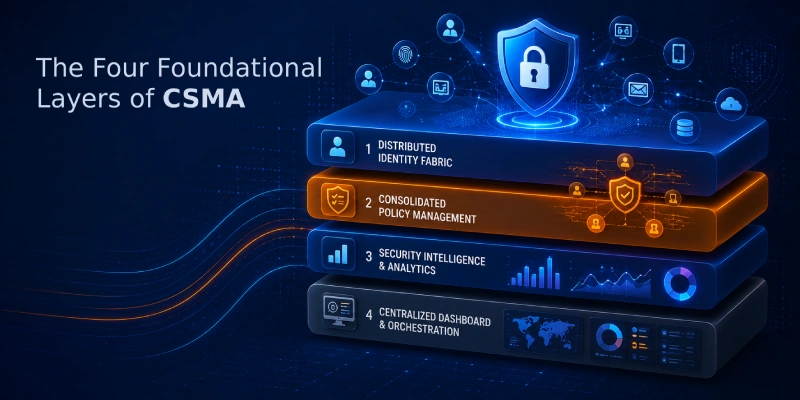
The Four Foundational Layers of CSMA

Gartner frames Cybersecurity Mesh Architecture around four supportive layers that let independent security tools interoperate as one system.

01
Distributed Identity Fabric
Provides decentralized identity management, adaptive access, directory services, and identity-proofing so trust decisions travel with the user or device, not the network segment.
02
Consolidated Policy Management
Translates one central policy into the native configuration language of each individual tool, so firewalls, identity providers, and cloud controls enforce the same rules consistently.
03
Security Intelligence & Analytics
Aggregates signals from every connected tool into a shared analytics layer, correlating weak signals across endpoints, identities, and cloud workloads into a single threat picture.
04
Centralized Dashboard & Orchestration
Gives security teams one console for visibility, detection, and response, replacing dozens of disconnected dashboards with a single operational view.

Why Organizations Are Adopting CSMA

Adoption is accelerating because CSMA addresses the operational reality security leaders face every day, not just a theoretical architecture problem.

  • Consolidated visibility: one operational view replaces dozens of disconnected consoles.
  • Faster detection and response: correlated telemetry shortens the time between an early warning sign and a confirmed incident.
  • Lower breach impact: organizations with mature, integrated security ecosystems consistently report smaller financial and operational impact per incident.
  • Better use of existing investment: CSMA extends the value of tools already purchased instead of replacing them.
  • Support for hybrid and multi-cloud growth: policy and identity travel with the workload, not the network segment.

CSMA vs. Traditional Perimeter Security

A side-by-side look at how the mesh model fundamentally differs from legacy perimeter-based approaches.

Dimension Traditional Perimeter Security Cybersecurity Mesh Architecture
Security boundary Fixed network perimeter Identity- and asset-centric, follows the resource
Tool integration Siloed, point-to-point Composable, interoperable via shared layers
Policy enforcement Duplicated per tool Centralized, consistently applied
Scalability Rigid, hardware-bound Elastic, cloud- and API-driven
Response speed Manual correlation across tools Automated, real-time correlation

A Practical Framework for Implementing CSMA

Organizations do not need to rip and replace their entire stack to begin adopting a mesh approach. A phased framework works better in practice.

1
Audit the existing security stack
Inventory every tool, license, and vendor in use, and map which ones already expose APIs for integration versus which remain closed silos.
2
Establish an identity fabric first
Centralize identity and access management before anything else, since almost every other CSMA layer depends on reliable, portable identity data.
3
Standardize on a shared policy layer
Pick a policy engine that can translate one rule set into the native syntax of firewalls, cloud consoles, and endpoint agents.
4
Feed everything into unified analytics
Route logs, alerts, and telemetry from each tool into a common analytics and SIEM layer so correlation happens automatically.
5
Pilot, measure, then expand
Start with one business unit or cloud environment, measure detection and response-time gains, then scale the mesh outward.

Benefits Organizations Are Seeing

Measurable outcomes reported by teams that have adopted a mesh approach.

Fewer blind spots between cloud, identity, and endpoint security domains.
Reduced alert fatigue as correlated incidents replace duplicate, low-context alerts.
Shorter mean time to detect and respond across the security operations center.
Improved audit and compliance reporting through consistent, centrally enforced policy.
A clearer business case for security spend, since existing tools are optimized before new ones are purchased.

Common Challenges — and How to Overcome Them

Reality Check

CSMA is still an emerging discipline. The absence of a single universal standard and the limited number of vendors offering complete, end-to-end mesh platforms remain the biggest adoption barriers.

Most organizations run into three recurring obstacles: unclear internal ownership of the initiative, engineering effort required to integrate legacy tools, and uncertainty about which platform will still be relevant once industry standards mature. The most effective response is to start narrow — unify identity and policy for one environment first — and expand the mesh only after early wins are measured and validated.

Frequently Asked Questions

Quick answers to the most common questions about Cybersecurity Mesh Architecture.

Is Cybersecurity Mesh Architecture a product or a strategy?
It is a strategy and reference architecture, not a single product. CSMA is implemented by integrating and orchestrating tools an organization already owns, layered with shared identity, policy, and analytics capabilities.
How is CSMA different from Zero Trust?
Zero Trust is a security principle — never trust, always verify. CSMA is the architectural framework that operationalizes that principle at scale, connecting identity, policy, and analytics tools so zero-trust decisions can be enforced consistently across a distributed environment.
Do small and mid-sized organizations need CSMA?
Yes. Mid-sized organizations often have the same tool sprawl and hybrid infrastructure as larger enterprises, with fewer security staff to manage it. A mesh approach helps smaller teams get more value from the tools they already have rather than adding headcount.
What is usually the first step toward CSMA?
Centralizing identity and access management. Since every other layer — policy, analytics, and orchestration — depends on reliable identity data, most successful implementations start there before expanding to policy and analytics integration.
Does adopting CSMA mean replacing current security tools?
Not necessarily. CSMA is designed to make existing tools interoperate through shared layers rather than forcing a full replacement. Tools that cannot integrate at all may eventually need to be replaced, but the initial focus is integration, not removal.

Ready to move from fragmented tools to a unified security mesh?

Talk to our security architecture team — visit our website to get started.

Get Started
CSMA Cybersecurity Mesh Distributed Security Architecture Zero Trust Security Identity Fabric Composable Security Unified Security Policy Security Tool Integration

Leave a Reply

Your email address will not be published. Required fields are marked *

Categories
Our Latest Posts:

Apply for a better career

Get in touch

Give us a call or fill in the form below and we’ll contact you. We endeavor to answer all inquiries within 24 hours on business days.