
Artificial Intelligence
How to Reduce AI Inference Costs Without Killing Quality
How to Reduce AI Inference Costs Without Killing Quality Home

Closing the gap between data creation and data action with edge processing and intelligent interpretation.
Edge computing and AI power real-time business intelligence by processing data at its source instead of a distant cloud server, and using AI models to interpret that data instantly. This combination reduces decision latency from seconds or minutes down to milliseconds, allowing businesses to detect problems, spot trends, and act on insights while the moment still matters.
Most business intelligence systems were designed for a slower, more predictable world — one where a daily or weekly report was enough to guide decisions. That model breaks down in environments where conditions change by the second: a machine overheating on a production line, a sudden spike in checkout abandonment, or a delivery vehicle falling behind schedule.
Sending every data point to a centralized cloud platform for processing introduces three recurring problems: network latency that delays insight, bandwidth costs that scale with data volume, and single points of failure when connectivity drops. For time-sensitive operations, even a few seconds of delay can mean a missed safety alert, a lost sale, or a costly equipment failure.
Edge computing refers to processing data physically close to where it is created — on a local server, gateway device, or the sensor itself — a core building block of the connected world's shift toward intelligent ecosystems, rather than routing everything to a remote data center. For business intelligence, this shift matters because it removes the round trip that traditionally separates data collection from data analysis.
Instead of waiting for information to reach the cloud, get processed, and return as an insight, edge computing allows analysis to happen on the spot. Only the relevant, distilled output — a summary, an alert, or an aggregated metric — is sent onward, which keeps networks lighter and dashboards faster to update.
Edge doesn't replace the cloud — Edge computing and cloud computing are complementary, not competing, approaches. The edge handles immediate, time-sensitive decisions, while the cloud remains essential for long-term storage, deep historical analysis, and training the AI models that run at the edge. Businesses evaluating this edge-to-cloud balance should also consider the hidden costs of cloud migration when deciding how to evolve their architecture.
Edge computing solves the location problem — getting processing power closer to the data. AI solves the interpretation problem — turning that raw data into a meaningful signal a business can act on. Our AI and Machine Learning services build exactly these kinds of predictive and anomaly-detection models for edge and cloud environments alike. Together, they convert a constant stream of numbers into intelligence that fits directly into daily operations.
Machine learning models deployed on edge devices can identify patterns that precede a problem, such as unusual vibration in machinery or a gradual dip in energy efficiency, and flag it before failure occurs. This shifts business intelligence from reporting what already happened to anticipating what is about to happen.
AI models running locally can continuously compare incoming data against expected patterns and immediately flag deviations — a security breach, a defective product on an assembly line, or an unusual transaction. Because the analysis happens on-site, alerts reach decision-makers in near real time rather than after a batch-processing delay.
Increasingly, AI layers built on top of edge data pipelines can summarize complex metrics in plain language, allowing non-technical stakeholders to understand what's happening without interpreting raw charts. This makes real-time business intelligence accessible beyond data teams, extending its value across an entire organization.
Sensors on production equipment detect early signs of wear, and AI models trigger maintenance before a breakdown halts the line.
In-store cameras and point-of-sale systems analyze footfall and inventory in real time, enabling instant restocking or layout decisions.
Wearable and bedside devices process vital signs locally, alerting clinical staff to critical changes within seconds.
Fleet-mounted edge devices process route, fuel, and driver-behavior data on the vehicle itself, enabling live rerouting decisions.
Smart grid sensors detect load imbalances and adjust distribution locally, reducing outages and improving efficiency.
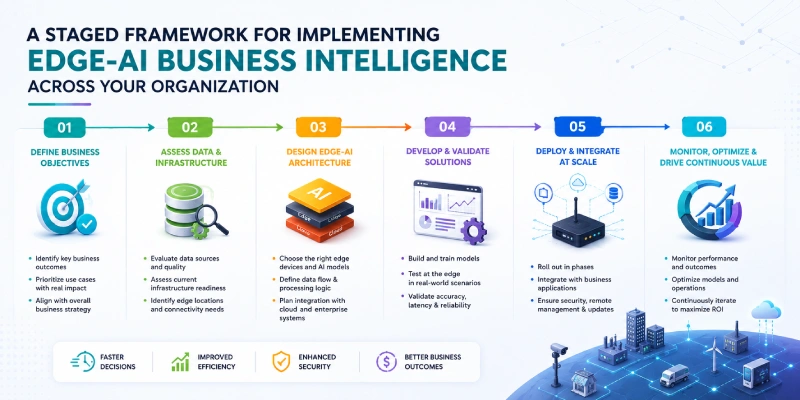 A staged framework for
implementing edge-AI business intelligence across your organization
A staged framework for
implementing edge-AI business intelligence across your organization
Organizations exploring this shift don't need to overhaul every system at once. A staged approach reduces risk while building measurable value:
Identify use cases where seconds matter — safety alerts, quality control, fraud detection, or customer experience moments — rather than applying edge AI everywhere at once.
Deploy sensors, gateways, or edge servers close to the identified data sources, choosing hardware that matches the processing load required.
Use pretrained or lightweight models suited for local inference, reserving heavier model training for the cloud.
Design pipelines so summarized insights flow to the cloud for historical analysis and model retraining, keeping the edge and cloud in sync.
Track decision latency, false-alert rates, and operational impact to refine models and expand the framework to new use cases.
Choosing the right balance between edge and cloud often depends on existing infrastructure, workload requirements, and business priorities. Our cloud computing solutions can help organizations determine where cloud-based BI fits best within their broader architecture.
| Capability | Traditional Cloud BI | Edge + AI-Powered BI |
|---|---|---|
| Data processing location | Centralized cloud servers | Local edge devices, near the data source |
| Typical decision latency | Seconds to minutes | Milliseconds |
| Bandwidth dependency | High — raw data streamed constantly | Low — only relevant insights are transmitted |
| Best suited for | Historical reporting, trend analysis | Live monitoring, instant alerts, on-the-spot decisions |
| Resilience during outages | Limited without connectivity | Continues operating locally |
Limited processing power on edge devices can constrain model complexity, which is why lightweight, purpose-built AI models are preferred over large general-purpose ones.
Distributed devices expand the attack surface — this is addressed through device-level encryption and strict access controls rather than relying solely on centralized cloud security.
Integration with existing legacy systems can slow adoption. Businesses that succeed typically start with a single, well-defined use case, prove its value, and expand incrementally rather than attempting an organization-wide rollout from day one.
As 5G connectivity expands and edge hardware becomes more powerful and affordable, the boundary between real-time operations and business intelligence will continue to blur. Decision-making will increasingly happen automatically at the point of data creation, with human teams focused on strategy rather than manual monitoring. Businesses that build this capability early will be positioned to respond to change faster than competitors still relying on delayed, centralized reporting.
Stay ahead with more insights on emerging technology trends shaping the future of business.
Visit our websiteHow to Reduce AI Inference Costs Without Killing Quality Home
Edge Computing & AI for Real-Time Business Intelligence Home Edge
Cybersecurity Mesh Architecture: Why Organizations Are Adopting It Home Cybersecurity