

General
Cybersecurity Mesh Architecture:Why Organizations Are Adopting It
Cybersecurity Mesh Architecture: Why Organizations Are Adopting It Home Cybersecurity
The Next Frontier in Smart Technology
Explore how ambient intelligence is reshaping smart technology in 2026 — from real-world use cases and key benefits to challenges and future trends shaping our connected world.
Imagine walking into your office and having the lights, temperature, and display settings adjust automatically to your preferences — without pressing a single button. Your calendar syncs with your commute time, your meeting room detects attendees and adjusts audio settings, and a subtle notification appears on the nearest screen to remind you of a task. This is not science fiction. This is Ambient Intelligence (AmI).
Understanding Ambient Intelligence is no longer optional — it is essential for anyone navigating the rapidly evolving landscape of smart technology. AmI represents a paradigm shift from reactive computing (where users command machines) to proactive computing (where machines anticipate and serve human needs in context). As organisations invest heavily in smart environments, edge computing, and IoT ecosystems, those who understand how these components converge will be the ones shaping tomorrow's digital infrastructure.
Ambient Intelligence (AmI) describes digital environments that are sensitive, adaptive, and responsive to the presence of people. Coined by the European Commission's ISTAG in the early 2000s and championed by researchers like Emile Aarts at Philips Research, AmI envisions a world where technology is woven into everyday environments — not placed on desktops or in data centres.
A key differentiator from standard IoT deployments is the degree of autonomy. While a smart thermostat responds to programmed schedules, an AmI system learns patterns, predicts behaviour, and proactively adapts — often before the user is even aware of a need.
Environments embedded with smart sensors — cameras, microphones, temperature sensors, RFID, biometrics — that continuously collect contextual data about users and physical space.
Machine learning algorithms process this data in real time to infer user intent, preferences, and needs — adjusting system responses with zero manual input.
The technology operates invisibly in the background. Users experience outcomes (comfort, convenience, productivity) without consciously interacting with any device.
Understanding the technical architecture behind AmI is critical for anyone designing, deploying, or maintaining these systems. An Ambient Intelligence ecosystem operates across four interconnected technology layers:
|
Perception Layer
IoT Sensors, RFID, Computer Vision, Wearables
|
Collect environmental & user data
|
|
|
Communication Layer
5G, Wi-Fi 6, Bluetooth LE, Zigbee, Edge Networks
|
Transmit data with ultra-low latency
|
|
|
Intelligence Layer
ML, NLP, Deep Learning, Context Engines
|
Process, interpret & predict behaviour
|
|
|
Interaction Layer
Voice UI, Haptic Feedback, AR/VR, Ambient Displays
|
Deliver seamless, non-intrusive responses
|
One of the most important AmI enablers is edge computing — processing sensor data locally rather than in the cloud. This reduces latency to milliseconds (critical for real-time responses), improves data privacy (sensitive data stays on-premises), and cuts bandwidth costs by up to 70%. This makes deployment leaner, faster, and more secure across any scale of operation.
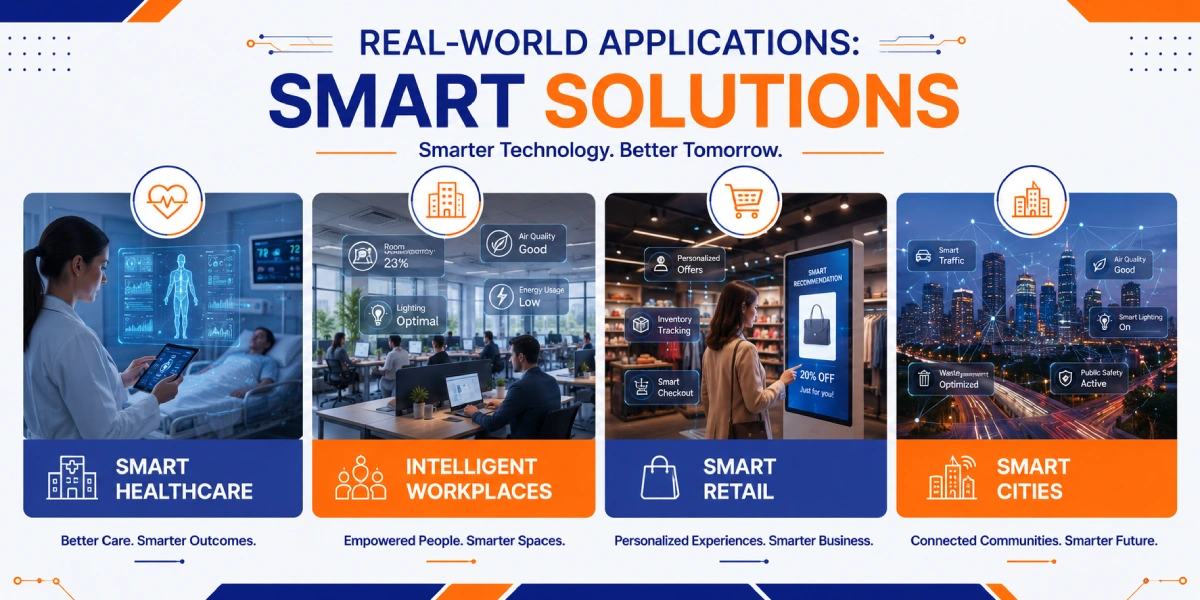
Ambient Intelligence is not a distant concept. It is deployed across industries today, driving tangible improvements in how people live, work, and interact with the built environment.
Hospitals deploy AmI to monitor patient vitals through ambient sensors without wearables, detect falls via computer vision, and auto-alert nursing staff. Mayo Clinic and Singapore's NUH demonstrate measurably improved patient outcomes.
Corporate campuses from Microsoft to Google integrate AmI principles: occupancy sensors optimise HVAC, meeting rooms auto-configure based on calendar data, reducing energy consumption by up to 30%.
Amazon's Just Walk Out technology uses ambient sensor arrays, computer vision, and real-time ML inference to track purchases without checkout lanes — managed by edge compute clusters at store scale.
Municipalities deploy AmI in adaptive traffic management, air quality monitoring, and smart waste collection — securing vast sensor networks and ensuring interoperability across complex city-wide systems.
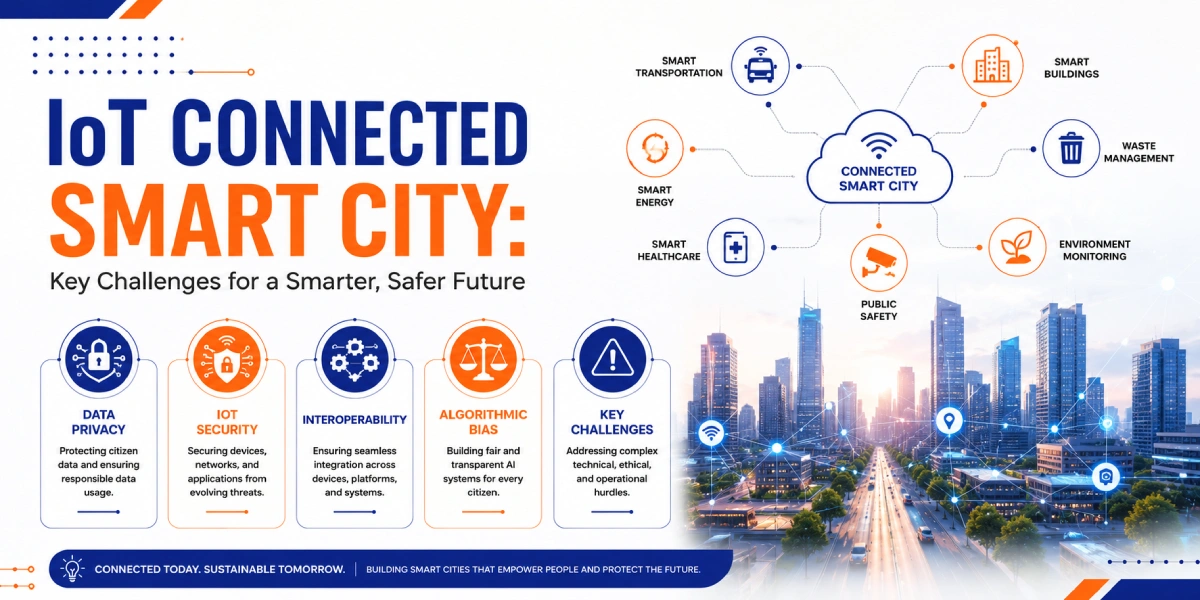
AmI systems continuously collect behavioural, biometric, and location data, triggering GDPR, PDPB (India), and CCPA obligations. Organisations must implement data minimisation, AES-256 encryption at rest, TLS 1.3 in transit, and clear retention policies.
Each sensor node is a potential attack surface. Enforcing zero-trust network architectures, regular firmware updates, device certificate management, and anomaly detection across the entire sensor mesh is non-negotiable. Reference: OWASP IoT Security Top 10 at owasp.org.
The IoT landscape is fragmented across Zigbee, Z-Wave, Matter, and Thread protocols. Investment in middleware platforms and API gateways, preferably aligned with the Matter standard supported by Apple, Google, and Amazon, is essential.
ML models that drive AmI decisions can encode biases from training data. An AmI healthcare system that misclassifies distress signals for certain demographics is an ethical and legal liability. Championing explainable AI (XAI) and model auditing protocols is critical.
A phased approach reduces risk while building internal competency. Here is a proven three-phase roadmap for any organisation introducing Ambient Intelligence capabilities.
Several converging technological advances will propel Ambient Intelligence into every facet of human life over the next decade. Staying ahead of these developments will be key to building the infrastructure of tomorrow.
Expected by 2030, delivering sub-millisecond latency and terabit-speed connectivity enabling real-time AmI across entire cities.
Brain-inspired chips like Intel's Loihi 2 will power always-on ambient systems at the edge with extreme energy efficiency.
Privacy-preserving ML techniques that train models across distributed sensor nodes without centralising sensitive data.
Entire buildings, campuses, and cities will have virtual counterparts enabling predictive maintenance and scenario simulation.
Next-gen AmI systems will detect emotional states through facial micro-expressions, voice tone, and biometrics for hyper-personalised responses.
IoT refers to the network of connected devices that collect and exchange data. Ambient Intelligence uses IoT as its sensing infrastructure but adds layers of AI, machine learning, and context-awareness to create proactively responsive environments. All AmI systems use IoT; not all IoT deployments constitute Ambient Intelligence.
A smart home is a simplified consumer application of some AmI principles. True AmI goes far beyond scheduling and remote control — it involves real-time contextual awareness, behavioural prediction, and seamless adaptation without user input. Enterprise and urban AmI deployments operate at vastly greater scale and complexity.
Key skills include IoT protocols (MQTT, Matter, Thread), edge computing and containerisation (Docker, Kubernetes at the edge), MLOps, real-time stream processing (Apache Kafka, Flink), cybersecurity for distributed systems (zero-trust, PKI), and API integration. Cloud certifications in AWS IoT, Azure IoT, and Google Cloud IoT are highly valuable for anyone building or managing AmI ecosystems.
Implement privacy-by-design from the outset: data minimisation, anonymisation, AES-256 encryption at rest, TLS 1.3 in transit, transparent user consent mechanisms, and regular Privacy Impact Assessments (PIAs). Edge processing that keeps sensitive data on-premises is a key privacy-enhancing strategy.
Leading platforms include AWS IoT Core + SageMaker Edge, Microsoft Azure IoT Hub + Digital Twins, Google Cloud IoT Core, and IBM Watson IoT. For open-source deployments: Eclipse IoT, Node-RED, and KubeEdge. Choice depends on cloud strategy, latency requirements, and data sovereignty needs.
Documented benefits include 20–35% energy cost reductions in smart buildings, 10–20% productivity gains in intelligent workplaces, up to 40% reduction in unplanned equipment downtime through predictive maintenance, and measurable improvements in patient outcomes in healthcare settings.
Ambient Intelligence is not a distant vision — it is the logical, inevitable evolution of the smart technology systems being built today. The convergence of IoT, edge computing, machine learning, and ubiquitous connectivity is creating digital environments that are not just connected but genuinely intelligent: environments that see, understand, and respond to human needs with unprecedented precision.
The imperative is clear: understand the architecture, embrace the skills needed to deploy and secure these systems, and champion the ethical frameworks that ensure AmI serves humanity. The organisations that invest in this capability today will define the standard for intelligent, human-centred technology for decades to come.
The technology is ready. The question is whether you are.
Explore cutting-edge insights on smart technology, IoT, ambient computing, and digital transformation — crafted for curious minds ready to build a smarter world.
Visit Our Website to Explore More InsightsCybersecurity Mesh Architecture: Why Organizations Are Adopting It Home Cybersecurity

Hidden Costs of Cloud Migration for Mid-Sized Businesses Home Cloud
Ambient Intelligence: The Next Frontier in Smart Technology Home Smart
Give us a call or fill in the form below and we’ll contact you. We endeavor to answer all inquiries within 24 hours on business days.