Technologies
API Gateway Architecture: Key Concepts Every Software Engineer Should Know
API Gateway Architecture: Key Concepts Every Software Engineer Should Know

A model that works in a notebook is only the start. Getting it into production — where it serves real users, stays reliable, and does not quietly degrade — is a different problem entirely. That gap is what MLOps exists to close.
Teams that invest in custom application development for ML often discover that the engineering around the model — pipelines, versioning, monitoring, rollback — costs more effort than the model itself. This guide walks through the full MLOps lifecycle, from experimentation to retired model, with the stages, pillars, tools, and failure modes you will actually meet.
MLOps applies DevOps principles to machine learning. The model is only one artifact in a larger system that includes data pipelines, feature stores, training infrastructure, deployment, monitoring, and feedback loops. Treat models like code, data like tests, and monitoring like production.
Adopting MLOps does not mean buying one platform. It means establishing practices: reproducible training, automated deployment, drift detection, and a clear path to roll back. Security matters too — see our deep dive on cybersecurity mesh architecture for how modern teams secure distributed ML services.
In traditional software, code defines behavior. In ML, data defines behavior — and data changes. Models trained last quarter on last quarter’s distribution can silently lose accuracy as user behavior, input patterns, or upstream features shift. Without monitoring, nobody notices until a stakeholder complains.
MLOps closes this gap by making the full lifecycle — data, training, deployment, monitoring — repeatable, automated, and observable. It borrows from DevOps and SRE, but adds ML-specific concerns: data versioning, feature consistency between training and serving, model lineage, and drift detection.
Before adding tools, map your current workflow. Many teams discover that hidden workflow bottlenecks — manual handoffs, untracked experiments, ad-hoc data pulls — block them more than any missing platform feature.
Every model moves through these stages. Some iterate quickly (experiment to deploy), others take longer (monitor to retire). The goal of MLOps is to make each stage repeatable and the transitions between them automated.
Data scientists explore data, prototype features, and train candidate models in notebooks or scripts. The output is a promising model plus the recipe to reproduce it — data version, feature code, hyperparameters, and environment.
The candidate model is evaluated on held-out data, checked for bias and fairness, and compared against the current production model. Offline metrics matter, but so do business-aligned checks: does it actually improve the outcome?
The model is packaged, versioned, and deployed — often behind a shadow or canary release first. Serving infrastructure must match the training pipeline’s feature engineering exactly, or the model receives inputs it was not trained on.
Once live, the model is watched for input drift, prediction drift, latency, error rates, and business metrics. Alerts fire when quality drops below thresholds. This is where most MLOps effort lives day-to-day.
When a model can no longer meet quality bars — or a replacement outperforms it — it is retired. Versioning and lineage mean you know which models served which traffic, and can audit decisions if needed.
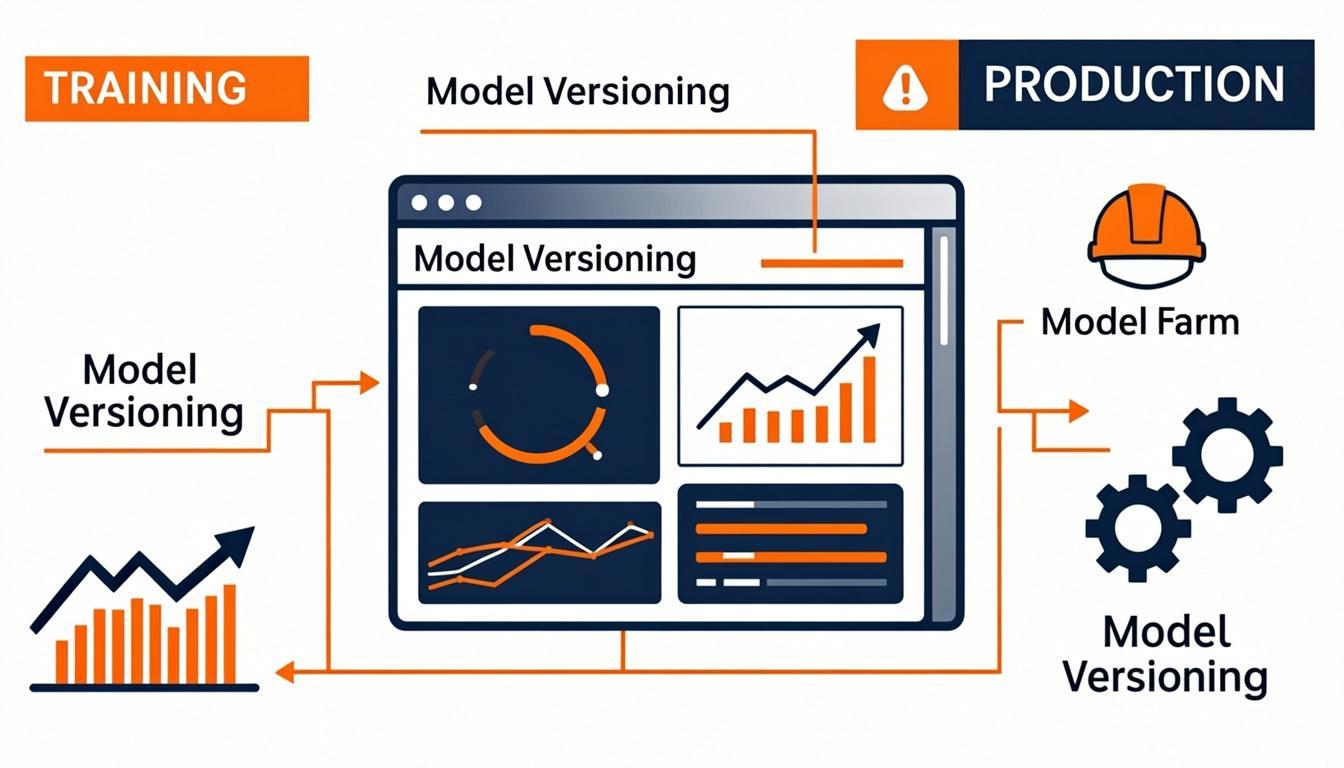 The MLOps pipeline connects training, versioning, deployment, and monitoring into one
repeatable flow.
Each pillar is a practice area with its own tools and failure modes. Weakness in one — usually data or monitoring — shows up as problems everywhere else.
Version datasets, document schemas, and keep feature definitions consistent between training and serving. A feature store — online and offline — is the standard solution.
Pin code, data, dependencies, and hyperparameters. Every training run should be re-runnable from a config, with results logged to an experiment tracker.
Every model artifact gets a version, lineage (which data and code produced it), and metadata (metrics, training date). A model registry tracks which version is staged, production, or archived.
Package the model behind an API, batch job, or embedded runtime. Support shadow deploys, canaries, and instant rollback. Serving must apply the same feature pipeline used in training.
Track input distributions, prediction distributions, latency, errors, and business KPIs. Detect drift early. Alerts should distinguish “model is broken” from “data changed.”
Access controls, audit logs, model lineage, bias checks, and data privacy. Who trained what, on which data, and who approved it for production? This matters in regulated industries.
The ecosystem is broad. The table below maps common tools to the layer they serve. You do not need all of them — pick one per layer and integrate well, rather than stitching many half-implemented tools together.
| Layer | What It Does | Common Tools |
|---|---|---|
| Data Versioning | Pins datasets and tracks changes | DVC, LakeFS, Pachyderm |
| Feature Store | Consistent features for training and serving | Feast, Hopsworks, Tecton |
| Experiment Tracking | Logs runs, params, metrics, artifacts | MLflow, Weights & Biases, Comet |
| Model Registry | Versioned model artifacts with stage labels | MLflow Registry, Vertex AI, SageMaker |
| Serving | Hosts the model behind an API or batch job | KServe, BentoML, Seldon, Triton |
| Monitoring | Detects drift, latency, quality issues | Evidently, Arize, Fiddler, Grafana |
| Orchestration | Schedules pipelines and manages runs | Airflow, Kubeflow, Prefect, Dagster |
| Platform | Managed end-to-end ML environment | Vertex AI, SageMaker, Azure ML |
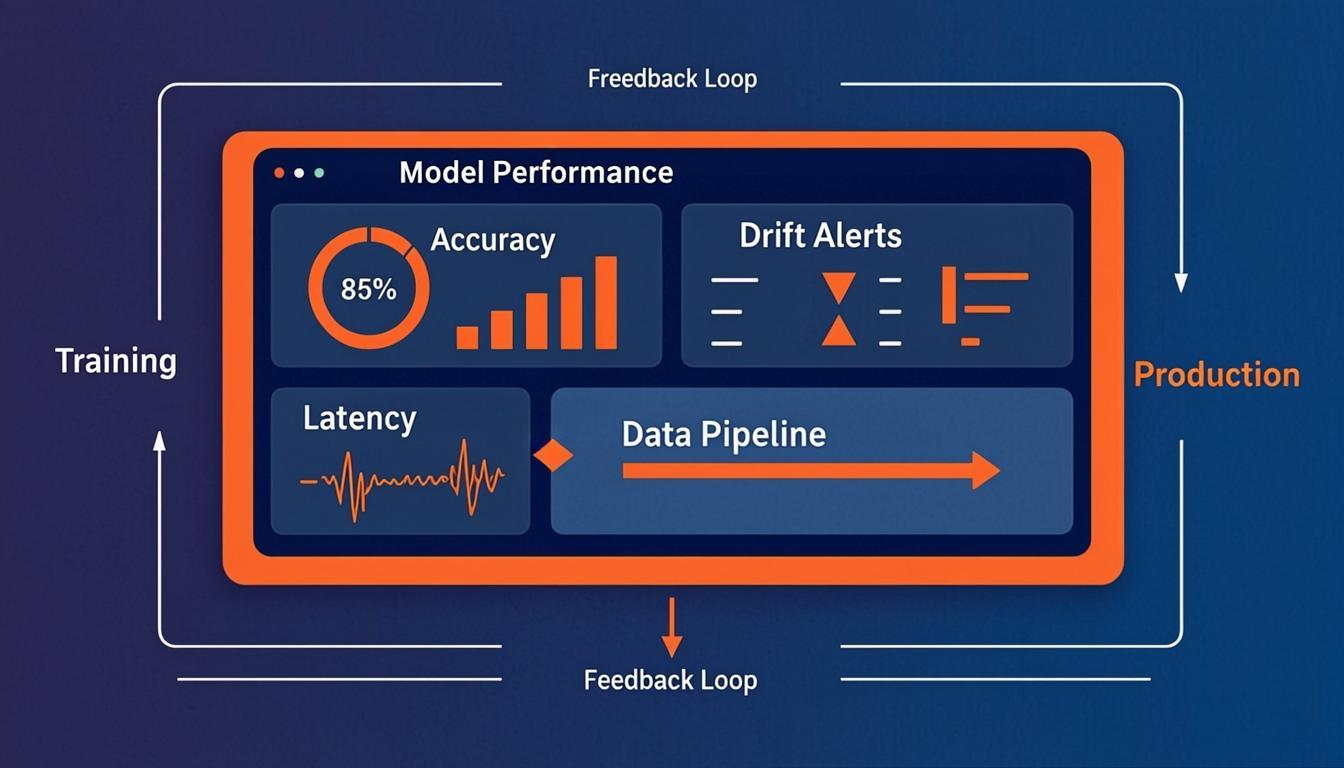 Monitoring catches drift early — before a silent quality drop becomes a visible
business problem.
You rarely ship a new model to all traffic at once. These strategies reduce risk:
New model receives real traffic but predictions are not returned to users. Compare against production silently.
Route a small percentage of traffic to the new model. Watch metrics. Roll forward or back based on results.
Split traffic between models and compare business metrics, not just model metrics. Useful for ranking and recommendation changes.
If any metric breaches a threshold, automatically revert to the previous model version. This safety net is what makes the other strategies safe.
Monitoring splits into operational metrics (is the service up?) and ML metrics (is the model still good?). Both matter — a model that returns 200 OK but predicts garbage is worse than one that fails loudly.
Google’s MLOps maturity model describes three levels. Most teams sit at Level 0 or 1; reaching Level 2 is a multi-quarter effort but pays off in reliability and speed.
| Level | Name | What It Looks Like |
|---|---|---|
| Level 0 | Manual | Notebook-driven, manual deploy, no monitoring. Fine for prototyping, risky for production. |
| Level 1 | ML Pipeline Automation | Training pipelines are automated and reproducible. Deployment is manual or semi-automated. Some monitoring exists. |
| Level 2 | CI/CD Pipeline Automation | Full CI/CD for data, code, and models. Deploys are automated with canaries and rollback. Drift detection triggers retraining. |
Do not try to jump from Level 0 to Level 2 in one project. Pick one pain point — usually deployment or monitoring — automate it, and expand from there. The goal is a repeatable practice, not a perfect platform on day one.
MLOps is not a tool you buy. It is a set of practices — reproducible training, automated deployment, drift monitoring, and safe rollback — that make ML reliable in production. The model is one artifact; the system around it is what determines whether users get a good experience or a silent degradation.
Start with one pain point, automate it, and expand. Whether you are building ML infrastructure from scratch or improving an existing pipeline, custom application development with MLOps baked in from the start saves rework later — and security architecture should be part of that design, not bolted on after.
Not sure where your ML pipeline stands? Our team can assess your current workflow, identify the bottlenecks that block shipping, and build the MLOps practices that fit your stack.
Talk to Our MLOps TeamAPI Gateway Architecture: Key Concepts Every Software Engineer Should Know
How to Reduce AI Inference Costs Without Killing Quality Home
Edge Computing & AI for Real-Time Business Intelligence Home Edge